Statcounter
Monday, June 16, 2014
Emily & Shui
Emily: "My style is comfy. Shui inspires my fashion. He's a designer. I see the things that he makes and they inspire me to put together something that suits me and in his aesthetic."
Shui: "My designs are casual and understated"
TorontoVerve: "What's the best advice you've ever received and from whom?"
Emily: "Mother always told me to be smart."
Shui: "My mother told me to be a good person."
TorontoVerve: "And are you doing what your mother told you?"
Shui: "I'm trying my best."
Check out Shui's Tumblr, which he describes as "very dark. Sometimes I express what I think through design...mostly garments."
Sunday, June 15, 2014
Kwame
"My style is a mix of vintage and new. Back in the day, I used to wear baggy clothes, but my friend Simone convinced me to wear things outside of my box. I recently bought a vest with silver polka dots on silver. It kinda looked weird to me, but I took a chance. Now people often compliment me on my fashion sense."
Saturday, June 14, 2014
Anna
Anna: "My style is whatever I can find in my closet or the thrift store. I get my inspiration from my roommate. We always bounce ideas off of each other when it comes to fashion."
TorontoVerve: "What's the best advice you've ever received and from whom?"
Anna: "My best friend Matt recently told me that you should judge people by their worst and not by their best and that will definitely give you a good idea of who they are as an individual."
We previously captured Anna's street style on a rainy day last fall.
Friday, June 13, 2014
Nikki
"My style doesn't have to have name-brand. I just have to be able to rock it. RuPaul inspires me. He's a gorgeous man who plays a beautiful woman."
Thursday, June 12, 2014
NKO
"My style is Thom Browne. I think he makes the most beautiful menswear."
NKO (pronounced Nico) and the Saint Genet Theatre Company are presenting a dance production called Paradisiacal Rites for Luminato at the Museum of Contemporary Canadian Art until Saturday, June 14th.
Click here for showtimes.
Wednesday, June 11, 2014
Tara
"My style is Rock 'N' Roll. Punk rocker Wendy O. Williams inspires me. I'm into her music."
Tara is a tattooer at New Tribe on Queen Street West. She plans on getting another tattoo this month.
"My best friend Nina and I will be getting matching tattoos -- probably something related to South Park."
Coincidentally, we shot Tara's street style 4 years ago when she was blond.
Tuesday, June 10, 2014
Heather
Heather: "I usually wear utilitarian clothing -- things that are practical and cute. Sometimes things I find in the garbage. And I like to wear them for days on end until they get really stinky. I'm a mess right now. I haven't showered. I rarely wash my hair. It's great."
TorontoVerve: "Is there anyone who inspires your style?"
Heather: "Anyone I see, really. Hobos. They wear practical clothing for all weather."
TorontoVerve: "What's the best piece of advice you've ever received and from whom?"
Heather: "Recently, my friend gave me advice because I was like really overwhelmed emotionally and was mean to people and I told him 'I can't stand being mean to people. What do I do?' He said, 'you've been through a really stressful situation recently and you should take a step back and know you're a good person and you'll get over your stress.' It wasn't the best advice that I've ever received, but it was the best advice I received yesterday. It meant a lot. He gave me a hug too."
Monday, June 9, 2014
18-Year-Old Morgan Baskin Wants Mayor Rob Ford's Job
And that's no joke. The young candidate has been hitting the media circuit and impressing audiences with her grace and moxie, but it’s her compelling speeches that are really getting people's attention.
At the recent Ethnic Press Debate, Baskin held her own against frontrunner candidates Olivia Chow, John Tory and Karen Stintz -- not bad for someone who’s also studying to write her final high school exams.
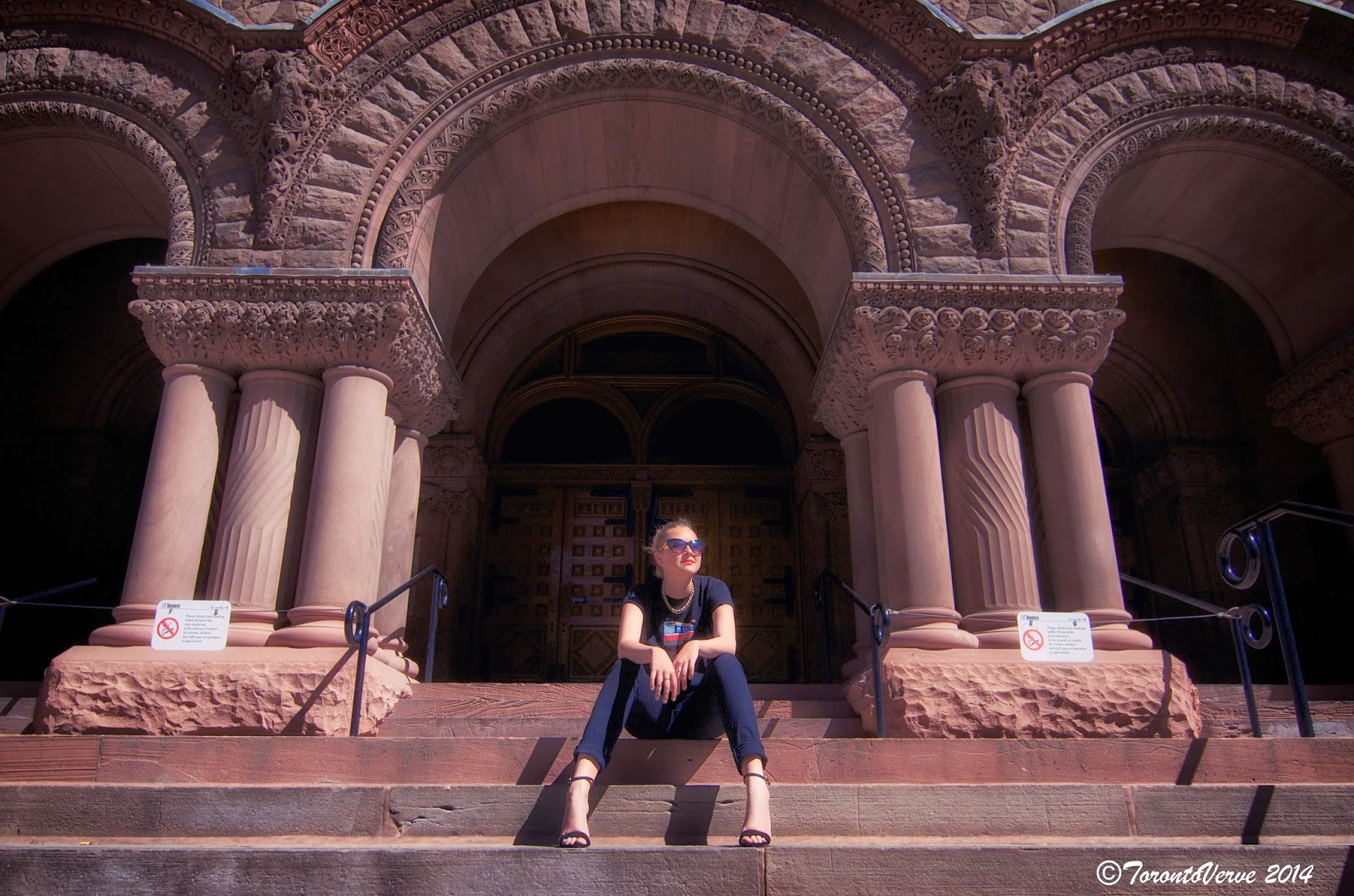
TorontoVerve caught up with the teen politician at City Hall to talk about family, politics, fashion and the elephant in the room.
TorontoVerve: I believe congratulations are in order. You were recently featured in the Torontoist as a political cartoon. How do you feel about that?
Morgan Baskin: I think it’s maybe the thing that I’ve been the happiest about. The cartoon is kinda like a ‘I’ve made it’ moment (laughs).
TV: Do you think its caption: “Hasn’t been ruined by life. Yet.” is a critique of your lack of experience to run for mayor? And what do you say to those people who are more focussed on your age than your policies?
MB: I don’t know if it’s a critique. I think it can be a positive. I do think that that caption can be taken either way. “Hasn’t been ruined by life. Yet.” Maybe it’s a critique of the world and not of me. I do think that the focus on my age is interesting in terms it is kinda like lip service to young people. We’re often told that we can do anything -- we should just get in there and do it. And when we do, we’re then told we’re not ready. “You don’t have any experience. Get some experience first.” And especially for Millennials, there are situations where we can’t. So please don’t get upset with us if we just jump in to get that experience because no one is willing to give us that experience.
TV: Does it frustrate you when you’re told that you should slow down -- you expect the brass ring too quickly?
MB: Well, I think for me -- yes I want the brass ring. Yes, I want it quickly. Doesn’t everyone? I also understand that you need to work hard to get there. I’m not that naive to think that it will just happen for me because I signed the papers, but I think we all want the brass ring quickly and when we critique people who are reaching for it, I think there is often a little bit of “I wish I was reaching that high. I wish I was going for it.” I’m not trying to be self-centered because I’ve been that person too, but when [some adults] critique young people who are doing well, sometimes they kinda wish that they did just as well when they were that young.
TV: Before we go further into your political career, tell us about your childhood. What kind of kid were you?
MB: I was a pretty precocious child. From a very young age, I wanted to be the queen of everything when I grew up. My first word was go as in GO! Not let’s go, but YOU, GO! And I used to line up my parents. At the time I had three -- I’ve since acquired an extra. I used to line them up to make sure everyone’s outfits were matching -- including mine. My style was a little different then. I just wanted everyone to wear overalls. When I was 6-years old, I once asked my mom: “did you hear about the murder last night?” I’ve always been a kid who paid a lot of attention to the news and was really focussed on the world around me. I also spent a lot of time with adults who talked about real things and treated me like a little adult. And when I didn’t act like a little adult, well, I got sent to bed. I learned very quickly to speak like an adult and pay attention to the world around me. There are good and bad things about that.
TV: It’s interesting that at a very young age you were aware of murder and crime.
MB: Well, I grew up in Regent Park. I technically lived in Corktown, but just across the street was Regent Park and I had a lot of friends there. My parents never hid me from the world around me and they always encouraged everyone to take me seriously and not just tell me I was right or let me win because I was a kid, and I really appreciate that because it gave me a very broad knowledge. But, in some ways I was sheltered. I wasn’t allowed to watch Disney movies and we didn’t have cable, but I…
TV: Why weren’t you allowed to watch Disney movies?
MB: My parents were really uncomfortable with a lot of the gender rules and inherent racism in those Disney movies and they wanted me to wait until I was old enough to watch them. I mean, I watched them at other people’s houses, but it wasn’t something that was encouraged in my own house.
TV: What is your family like?
MB: My mom, Beth Baskin, works in social justice and the church. She’s very passionate about working with children. My dad, Keith Nunn, is a self-made man who works in IT. My extra parents: Bear Bergman is a prominent queer writer who works a lot in theatre and storytelling, and J Wallace works in gender violence prevention and issues surrounding homophobia and gender within the Toronto District School Board. But, mostly I have a very large extended family that includes lots of people who are technically not biologically-related to me; including people I call grandma (laughs). At Christmas, there are close to 30 people sitting around our dinner table and my extra parents are Jewish so I often describe my family as a mixed bag of very loud and loving people (laugh).
TV: How is your family helping you in your campaign?
MB: A lot of them have made donations, which is very nice and helpful, but often they help ground me as a person and teach me about family. I’m not Morgan the political candidate. I’m Morgan who needs to wash the dishes, which I value a lot.
TV: You’ve been passionate about politics since you were 14. Who are some of your political heroes and why?
MB: Though I will admit to not knowing a lot about her politics because I don’t follow American politics, Hillary Clinton. I like her ability to be sassy but polite and I appreciate her standing up to criticism surrounding her gender, as well as not taking no for an answer when she knows she’s doing the right thing. I also love her dedication to being a connoisseur of pant suits (laughs). And I really admire journalist Jane Jacobs and her intense motivation to make the city a better place. Finally, Dan Heap because he had a strong political legacy as someone who was really dedicated to politics to change the world and make people’s lives better, which is also my political philosophy. I’m not in politics to further my own career as much as I am to make people’s lives better and change the world.
TV: You decided to run for mayor because you were frustrated with the lack of youth issues being discussed. What are some of the youth issues that you feel are typically neglected by City Hall?
MB: Ah, everything. I think the one that often gets talked about is youth unemployment. Usually the conversation is “how can we help those young people?” instead of “how can we help those young people help themselves?,” which I think is a very different conversation. I don’t think it’s about handing young people jobs or making jobs for them. It’s about helping young people understand how to reach their full potential. I also think they neglect conversations that are really important to young people like the environment, equality, education and housing. Unfortunately, a lot of the inclusion of young people in political conversations is token today.
TV: On your campaign website, it says that your plan is to activate Toronto with digital, global and green solutions. Can you briefly share how your perspective in these areas will be different?
MB: There is a lot of potential using technology to make people’s lives better. Technology can help people with disabilities or language barriers get around the city more easily. I think it’s unfortunate that the TTC doesn’t have an official app that tells people when the next bus in coming. It was a college student who developed that technology. Many of the TTC’s shortcomings would be less frustrating by knowing what’s going on.
I also think that I bring a very different perspective in terms of the environment. I’m desperate for change. I’m not like “oh, that would be nice for my grandkids.” No, no, no. I don’t want to have kids if we don’t solve this problem. I don’t really feel like living on this planet if we don’t solve this problem.
And for global, I bring a different perspective because I don’t know what this city would look like without immigrants. I don’t. This is super weird to say, but when I lived in France I experienced a lot of discomfort around how not diverse it was. I was so hyper-aware of the fact that the girls wearing hijabs were sitting at the back of the bus. And there weren’t any rules around that or anything, but there was this cultural division and cultural racism that I was so hyper-aware of because I’ve never really seen it before. Not that there isn’t racism in Toronto. There definitely is. I can’t understand the immigrant experience because I grew up here, but I do think we should do better at making that experience a really positive one and making sure that people with PHDs aren’t driving taxis. That’s not using the people who live in our city in the best way to make our city and their life better. That’s us falling short. That’s us not doing the right thing. Also, I’m a little sick of living in Toronto and hearing Torontonians call it a world class city and hearing no one else call it that. I think Torontonians are happy to say that in Toronto, but not outside of Toronto. I think that we need to remember to be proud of ourselves. We are a great city and there are lots of things that make us different and lots of things that can make us stand on that stage and can make us world class, but we need to remember to not sit behind everyone else and wait for someone to take that lead. Instead, we really need to take that lead and walk forward with that pack as opposed to trailing behind saying, “me too! We’re world class -- I think. Maybe. Can someone check?” We do that classic Canadian thing and we do it with our music industry, our food and with so many things. I get so frustrated. We are awesome! Stop being so Canadianly polite about it. We’re great! Yell it everywhere. Please and thank you. And I’d love to have a mayor who would visit Hollywood with the film department and talk about how great we are. I’m a little sick of our city pretending to be New York.
TV: I know what you mean. I hate it when we constantly ask Hollywood celebrities what they think of Toronto when they’re here for TIFF.
MB: Exactly! People don’t think you’re great if you’re always asking if you’re great. People think you’re great when you believe you’re great.
TV: You recently spoke at the Ethnic Press Roundtable Debate with some of your opponents. What was that experience like for you?
MB: Terrifying (laughs). I mean in lots of ways it was a lesson in how people always stick to their scripts. I didn’t always answer every question with “Because Youth Matter.” That’s not the answer to every question. And a lot of people really stuck to repeating their election speech over and over again. When I didn’t stick to the script, I ended up with a whole bunch of quotes in newspapers. I spoke from the heart. I spoke with passion and I really meant what I said. I think that reporters can hear that. There’s a reason why John Tory doesn’t have a quote in many newspapers. Although he spoke about important things and made good points, he didn’t speak with passion. Olivia Chow did the exact same thing. Her opening remarks were her campaign speech reworded. Olivia Chow, we heard you say that. We want to hear something different. We want to hear about what you’re passionate about. We don’t want to hear you reading from a page. And I really believe that’s where I’ve had this advantage of connecting with people because I’ve had that passion, and I’ve said something different every time. If you ask me a question, I’ll give you an answer because that’s what you deserve as a resident in this city. It shouldn’t be a radical thing, but it seems to be a thing that a lot of politicians don’t understand.
TV: Maybe they don’t go off script because they can’t check with somebody about what their opinion should be.
MB: Early on, my campaign manager and I had a conversation where I was like “I can’t do this if I need to check with you on everything. I can’t. I can’t be that candidate who is just saying what you’ve written down for me.” I value his opinion incredibly and I do think it’s important to discuss strategy, but if someone asks me a question, I’m going to speak from the heart -- even if it’s about something that we haven’t previously discussed. Everything that I have said, I believe in. If I say things that I don’t believe in, you can tell and if I’m speaking through my campaign manager, people can tell. The most important thing for a politician to do is to say what they believe in, and if people think that they’re genuine, they’ll vote for them.
TV: That debate was considered vastly tame compared to the ridiculously contentious one back in March with Mayor Rob Ford. How would you handle yourself in a debate situation where there’s yelling and mud-slinging?
MB: I’d probably stop and check my Twitter, where interesting people are asking interesting questions. I really think it’s a failure of democracy when you’re yelling and throwing mud at each other. We’re not American. I don’t want to see American politics come here. I really think it’s important to be polite and answer questions properly. If you want to make your point, it’s ok to be a little sassy, but yelling and making personal attacks is inappropriate in any context. If someone’s personal life is a disaster, you can comment on that, but don’t attack them. That debate in March made me extremely uncomfortable because I knew there were a lot of people around the world watching it. I think it’s unfortunate when politics turn into yelling. If you can’t win based on the words coming out of your mouth, you’ve got a problem.
TV: One of the biggest issues in this race is transportation and where to find the money for the much-needed downtown-relief, which is estimated to cost 3 billion dollars. You propose a more grass-roots approach to solving the problem. If elected, can you explain how that will look?
MB: I think we need to have a multi-prong solution. I think we need to find money here, I think we need to find money in the GTA, I think we need to find a little bit of private money and I also think we need to tell the provincial and federal governments that “enough’s enough.” And this is where I get super frustrated. I’m like “please, please let me help now and don’t hand this problem to me in 20 years when we’ve also done nothing.” I really think we need to listen to some experts. I do not have a transit or city planning degree. I’m here to listen to those people and be the voice of the people who don’t have those degrees, but have to live with [the transit problem] everyday. I feel a lot of discomfort around politicians sitting in a room with maps and markers. Metrolinx has a plan. Let’s find the money and let the TTC and Metrolinx do it. Let’s stop changing our minds. We have been talking about the downtown-relief line since before I was born. I’m done talking. Thank you very much.
TV: Where do you stand with the Toronto Police Force’s practice of carding (police stopping and documenting people on the street)?
MB: Ugh, it’s a way of the police force institutionalizing racism. In Regent Park, I’ve seen people get carded. I was never carded. Why not? I’m a young person. Was I not carded because I’m a young girl? I saw a lot of young black men get carded. And when you look at those numbers, white blond girls are not getting carded. Black men in Yorkville are not getting carded. No, it’s the young black man in Regent Park, in Moss Park and in St. James Town, and that is both classism and racism. It’s unacceptable and against our Charter of Rights. I mean, there’s no reason for the police to know where a young black man was at 2pm yesterday and it’s inappropriate to ask for it -- especially when young people don’t know that they can say no and walk away and [the police] are not telling them. I’ve heard the police’s perspective and I don’t agree. I think the police do a lot of great work and I support them, but we can’t let the police do whatever they want. It’s wrong.
TV: In response to the #YesAllWomen campaign, you revealed that you were getting inappropriate advances from male admirers through your professional email and Facebook accounts. Although you’ve gotten tremendous support for sharing something so personal, you’ve also received some backlash through social media. How do you feel about the negative comments you received?
MB: I understand the place where some of them are coming from. I do understand that there are thoughtful young men out there who really don’t understand what they’re doing is wrong and I’m aware that often it’s more a societal problem. It’s not fun to hear people tell you that you’re not smart and you’re ugly and a slut. I’m really appreciative of the people who supported me and told me that I was doing the right thing. Unfortunately, you can’t make everybody happy.
TV: The experience has obviously tainted everything for you. In an interview, you said that you probably wouldn’t have run for mayor had you known this was going to happen. So how do you bounce back from all that and push forward in your campaign?
MB: I just have to remember why I’m here. I didn’t sign those papers because I wanted power or a date. I signed those papers because I wanted to give young people a voice in this election and I was going to yell as loud as I could until someone listened. I said this on Twitter the other day: I don’t wake up every morning believing in myself. There’s no magic way to do that. I wake every morning believing in this city and the people in it, and I’m going to stick around because I still believe in them.
TV: Mayor Rob Ford’s personal issues have put Toronto in a global spotlight. What are your thoughts about that and how it’s affected the city’s reputation?
MB: It certainly put [Toronto] on the map. I don’t think it necessarily gave us a bad reputation outside of political commentary in the wider world. I do think that there’s something to capitalize on there. I do think that whoever is elected in October should capitalize on that international media attention to talk about how great our city is and to really use that opportunity that we’ve been given. I’m not saying we’ve been given this opportunity for good reasons, but when someone hands you a spot on Jimmy Kimmel, you should take it. But I’m also aware of the embarrassment that Torontonians feel about that conversation, which is why we need to shift that conversation to be about what Toronto looks like on a whole and not focus on what Rob Ford does on weekends.
TV: So now that he’s in recovery, how do you think that’s going to play out on his campaign run?
MB: I have stopped speculating on the Fords’ campaign because honestly I’ve been wrong every time. It’s unfortunate that Rob Ford continues to be an elephant in the room in this election. The man’s in rehab and we were asked a question about him at the debate. The Sun, The Star, The Globe -- every Toronto paper has written 5 articles about it. We’re mayoral candidates here talking about our campaigns. Please ask us questions about our policies. I’m surprised that some people took the bait.

TV: What is your impression on some of your other opponents like Olivia Chow?
MB: I think Olivia Chow is a great politician who has done a lot of great work, but I don’t necessarily feel that she’s the best person for the job -- otherwise I’d be supporting her in her campaign. I’ve been really disappointed in her conversations about youth. I don’t think she’d be bad, but I don’t think she’s the best person for the job.
TV: John Tory?
MB: Again -- I think he’s a great guy, but I don’t think he’d be the best mayor in Toronto that we can have. But, I mean, I’m running for mayor so I think I’m the best (laughs). Like Chow, I’ve been really disappointed in his conversations about youth unemployment. Getting people rec centre jobs is not going to solve our youth unemployment problem.
TV: Finally, Karen Stintz?
MB: Karen Stintz did some interesting work as a TTC Chair. I was less impressed with her transit plan. I think that she’s incredibly earnest and she’s in it for the right reason, but again, I don’t think she’s the best person for the job. And she hasn’t even talked about youth unemployment and that’s a big negative.
TV: Obviously your generation will be paying close attention to your race. What advice do you have for young people who are considering a career in politics?
MB: Get in. Volunteer on someone’s campaign. Volunteer on my campaign (laughs). Or sign up to run or ask a reporter to shadow them. Really involve yourself and I say involve yourself because no one is going to ask you unfortunately. And I also think that paying attention means a lot. Read every newspaper article, watch every debate or look at Twitter. Twitter is really an interesting place for Toronto politics right now.
TV: So you’re turning 19-years old on June 19th. How will you be celebrating?
MB: We’ll probably be spending a couple of hours at my parent’s favourite bar. The other day, I tweeted that there will be no vomiting like a typical 19-year-old’s birthday party. When you’re running for public office, you gotta watch yourself a little more than usual.
TV: Some of us haven’t learned from that mistake.
MB: Yes, and some of us have (laughs).
TV: TorontoVerve is a street style blog so I’m obligated to ask: how would you describe your style?
MB: Classic with a modern twist and lots of sparkles. I own glitter hairspray (laughs). Also, I wear a lot of black clothes with red lipstick. I rock that look with the platinum blond hair. I have a lot of vintage clothes. Of course I’m not wearing anything vintage today as I say that (laughs). My prom dress was vintage and my favourite skirt is vintage.
TV: Who is your fashion inspiration?
MB: I take a lot of inspiration from street style blogs. The way that people dress for themselves is really interesting. I love to mix Audrey Hepburn with Blair Waldorf (Gossip Girl) and Coco Chanel with Taylor Swift. Classic but fun.
TV: How has fashion played in your mayoral run?
MB: I definitely dress a little less flamboyantly than I used to. There are a lot of bright colours, glittery things and gold lamĂ© in my closet that don’t get a lot of wear anymore. My blazers get pulled out a lot more often than the gold lamĂ© (laughs).
TV: And what’s the inspiration for what you’re wearing today?
MB: I adore this streetcar t-shirt and these are actually the heels I bought for prom -- they add a little sparkly gold to my outfit, which I love.
TV: Let’s close with a little word association.
MB: Sure.
TV: Youth.
MB: Matter.
TV: Family.
MB: Matter.
TV: Strength.
MB: Women.
TV: Mayor.
MB: Leadership.
TV: Toronto.
MB: Beautiful.
The 2014 Toronto Mayoral Election will take place on Monday, October 27, 2014.
At the recent Ethnic Press Debate, Baskin held her own against frontrunner candidates Olivia Chow, John Tory and Karen Stintz -- not bad for someone who’s also studying to write her final high school exams.
TorontoVerve caught up with the teen politician at City Hall to talk about family, politics, fashion and the elephant in the room.
TorontoVerve: I believe congratulations are in order. You were recently featured in the Torontoist as a political cartoon. How do you feel about that?
Morgan Baskin: I think it’s maybe the thing that I’ve been the happiest about. The cartoon is kinda like a ‘I’ve made it’ moment (laughs).
TV: Do you think its caption: “Hasn’t been ruined by life. Yet.” is a critique of your lack of experience to run for mayor? And what do you say to those people who are more focussed on your age than your policies?
MB: I don’t know if it’s a critique. I think it can be a positive. I do think that that caption can be taken either way. “Hasn’t been ruined by life. Yet.” Maybe it’s a critique of the world and not of me. I do think that the focus on my age is interesting in terms it is kinda like lip service to young people. We’re often told that we can do anything -- we should just get in there and do it. And when we do, we’re then told we’re not ready. “You don’t have any experience. Get some experience first.” And especially for Millennials, there are situations where we can’t. So please don’t get upset with us if we just jump in to get that experience because no one is willing to give us that experience.
TV: Does it frustrate you when you’re told that you should slow down -- you expect the brass ring too quickly?
MB: Well, I think for me -- yes I want the brass ring. Yes, I want it quickly. Doesn’t everyone? I also understand that you need to work hard to get there. I’m not that naive to think that it will just happen for me because I signed the papers, but I think we all want the brass ring quickly and when we critique people who are reaching for it, I think there is often a little bit of “I wish I was reaching that high. I wish I was going for it.” I’m not trying to be self-centered because I’ve been that person too, but when [some adults] critique young people who are doing well, sometimes they kinda wish that they did just as well when they were that young.
TV: Before we go further into your political career, tell us about your childhood. What kind of kid were you?
MB: I was a pretty precocious child. From a very young age, I wanted to be the queen of everything when I grew up. My first word was go as in GO! Not let’s go, but YOU, GO! And I used to line up my parents. At the time I had three -- I’ve since acquired an extra. I used to line them up to make sure everyone’s outfits were matching -- including mine. My style was a little different then. I just wanted everyone to wear overalls. When I was 6-years old, I once asked my mom: “did you hear about the murder last night?” I’ve always been a kid who paid a lot of attention to the news and was really focussed on the world around me. I also spent a lot of time with adults who talked about real things and treated me like a little adult. And when I didn’t act like a little adult, well, I got sent to bed. I learned very quickly to speak like an adult and pay attention to the world around me. There are good and bad things about that.
TV: It’s interesting that at a very young age you were aware of murder and crime.
MB: Well, I grew up in Regent Park. I technically lived in Corktown, but just across the street was Regent Park and I had a lot of friends there. My parents never hid me from the world around me and they always encouraged everyone to take me seriously and not just tell me I was right or let me win because I was a kid, and I really appreciate that because it gave me a very broad knowledge. But, in some ways I was sheltered. I wasn’t allowed to watch Disney movies and we didn’t have cable, but I…
TV: Why weren’t you allowed to watch Disney movies?
MB: My parents were really uncomfortable with a lot of the gender rules and inherent racism in those Disney movies and they wanted me to wait until I was old enough to watch them. I mean, I watched them at other people’s houses, but it wasn’t something that was encouraged in my own house.
TV: What is your family like?
MB: My mom, Beth Baskin, works in social justice and the church. She’s very passionate about working with children. My dad, Keith Nunn, is a self-made man who works in IT. My extra parents: Bear Bergman is a prominent queer writer who works a lot in theatre and storytelling, and J Wallace works in gender violence prevention and issues surrounding homophobia and gender within the Toronto District School Board. But, mostly I have a very large extended family that includes lots of people who are technically not biologically-related to me; including people I call grandma (laughs). At Christmas, there are close to 30 people sitting around our dinner table and my extra parents are Jewish so I often describe my family as a mixed bag of very loud and loving people (laugh).
TV: How is your family helping you in your campaign?
MB: A lot of them have made donations, which is very nice and helpful, but often they help ground me as a person and teach me about family. I’m not Morgan the political candidate. I’m Morgan who needs to wash the dishes, which I value a lot.
TV: You’ve been passionate about politics since you were 14. Who are some of your political heroes and why?
MB: Though I will admit to not knowing a lot about her politics because I don’t follow American politics, Hillary Clinton. I like her ability to be sassy but polite and I appreciate her standing up to criticism surrounding her gender, as well as not taking no for an answer when she knows she’s doing the right thing. I also love her dedication to being a connoisseur of pant suits (laughs). And I really admire journalist Jane Jacobs and her intense motivation to make the city a better place. Finally, Dan Heap because he had a strong political legacy as someone who was really dedicated to politics to change the world and make people’s lives better, which is also my political philosophy. I’m not in politics to further my own career as much as I am to make people’s lives better and change the world.
TV: You decided to run for mayor because you were frustrated with the lack of youth issues being discussed. What are some of the youth issues that you feel are typically neglected by City Hall?
MB: Ah, everything. I think the one that often gets talked about is youth unemployment. Usually the conversation is “how can we help those young people?” instead of “how can we help those young people help themselves?,” which I think is a very different conversation. I don’t think it’s about handing young people jobs or making jobs for them. It’s about helping young people understand how to reach their full potential. I also think they neglect conversations that are really important to young people like the environment, equality, education and housing. Unfortunately, a lot of the inclusion of young people in political conversations is token today.
TV: On your campaign website, it says that your plan is to activate Toronto with digital, global and green solutions. Can you briefly share how your perspective in these areas will be different?
MB: There is a lot of potential using technology to make people’s lives better. Technology can help people with disabilities or language barriers get around the city more easily. I think it’s unfortunate that the TTC doesn’t have an official app that tells people when the next bus in coming. It was a college student who developed that technology. Many of the TTC’s shortcomings would be less frustrating by knowing what’s going on.
I also think that I bring a very different perspective in terms of the environment. I’m desperate for change. I’m not like “oh, that would be nice for my grandkids.” No, no, no. I don’t want to have kids if we don’t solve this problem. I don’t really feel like living on this planet if we don’t solve this problem.
And for global, I bring a different perspective because I don’t know what this city would look like without immigrants. I don’t. This is super weird to say, but when I lived in France I experienced a lot of discomfort around how not diverse it was. I was so hyper-aware of the fact that the girls wearing hijabs were sitting at the back of the bus. And there weren’t any rules around that or anything, but there was this cultural division and cultural racism that I was so hyper-aware of because I’ve never really seen it before. Not that there isn’t racism in Toronto. There definitely is. I can’t understand the immigrant experience because I grew up here, but I do think we should do better at making that experience a really positive one and making sure that people with PHDs aren’t driving taxis. That’s not using the people who live in our city in the best way to make our city and their life better. That’s us falling short. That’s us not doing the right thing. Also, I’m a little sick of living in Toronto and hearing Torontonians call it a world class city and hearing no one else call it that. I think Torontonians are happy to say that in Toronto, but not outside of Toronto. I think that we need to remember to be proud of ourselves. We are a great city and there are lots of things that make us different and lots of things that can make us stand on that stage and can make us world class, but we need to remember to not sit behind everyone else and wait for someone to take that lead. Instead, we really need to take that lead and walk forward with that pack as opposed to trailing behind saying, “me too! We’re world class -- I think. Maybe. Can someone check?” We do that classic Canadian thing and we do it with our music industry, our food and with so many things. I get so frustrated. We are awesome! Stop being so Canadianly polite about it. We’re great! Yell it everywhere. Please and thank you. And I’d love to have a mayor who would visit Hollywood with the film department and talk about how great we are. I’m a little sick of our city pretending to be New York.
TV: I know what you mean. I hate it when we constantly ask Hollywood celebrities what they think of Toronto when they’re here for TIFF.
MB: Exactly! People don’t think you’re great if you’re always asking if you’re great. People think you’re great when you believe you’re great.
TV: You recently spoke at the Ethnic Press Roundtable Debate with some of your opponents. What was that experience like for you?
MB: Terrifying (laughs). I mean in lots of ways it was a lesson in how people always stick to their scripts. I didn’t always answer every question with “Because Youth Matter.” That’s not the answer to every question. And a lot of people really stuck to repeating their election speech over and over again. When I didn’t stick to the script, I ended up with a whole bunch of quotes in newspapers. I spoke from the heart. I spoke with passion and I really meant what I said. I think that reporters can hear that. There’s a reason why John Tory doesn’t have a quote in many newspapers. Although he spoke about important things and made good points, he didn’t speak with passion. Olivia Chow did the exact same thing. Her opening remarks were her campaign speech reworded. Olivia Chow, we heard you say that. We want to hear something different. We want to hear about what you’re passionate about. We don’t want to hear you reading from a page. And I really believe that’s where I’ve had this advantage of connecting with people because I’ve had that passion, and I’ve said something different every time. If you ask me a question, I’ll give you an answer because that’s what you deserve as a resident in this city. It shouldn’t be a radical thing, but it seems to be a thing that a lot of politicians don’t understand.
TV: Maybe they don’t go off script because they can’t check with somebody about what their opinion should be.
MB: Early on, my campaign manager and I had a conversation where I was like “I can’t do this if I need to check with you on everything. I can’t. I can’t be that candidate who is just saying what you’ve written down for me.” I value his opinion incredibly and I do think it’s important to discuss strategy, but if someone asks me a question, I’m going to speak from the heart -- even if it’s about something that we haven’t previously discussed. Everything that I have said, I believe in. If I say things that I don’t believe in, you can tell and if I’m speaking through my campaign manager, people can tell. The most important thing for a politician to do is to say what they believe in, and if people think that they’re genuine, they’ll vote for them.
TV: That debate was considered vastly tame compared to the ridiculously contentious one back in March with Mayor Rob Ford. How would you handle yourself in a debate situation where there’s yelling and mud-slinging?
MB: I’d probably stop and check my Twitter, where interesting people are asking interesting questions. I really think it’s a failure of democracy when you’re yelling and throwing mud at each other. We’re not American. I don’t want to see American politics come here. I really think it’s important to be polite and answer questions properly. If you want to make your point, it’s ok to be a little sassy, but yelling and making personal attacks is inappropriate in any context. If someone’s personal life is a disaster, you can comment on that, but don’t attack them. That debate in March made me extremely uncomfortable because I knew there were a lot of people around the world watching it. I think it’s unfortunate when politics turn into yelling. If you can’t win based on the words coming out of your mouth, you’ve got a problem.
TV: One of the biggest issues in this race is transportation and where to find the money for the much-needed downtown-relief, which is estimated to cost 3 billion dollars. You propose a more grass-roots approach to solving the problem. If elected, can you explain how that will look?
MB: I think we need to have a multi-prong solution. I think we need to find money here, I think we need to find money in the GTA, I think we need to find a little bit of private money and I also think we need to tell the provincial and federal governments that “enough’s enough.” And this is where I get super frustrated. I’m like “please, please let me help now and don’t hand this problem to me in 20 years when we’ve also done nothing.” I really think we need to listen to some experts. I do not have a transit or city planning degree. I’m here to listen to those people and be the voice of the people who don’t have those degrees, but have to live with [the transit problem] everyday. I feel a lot of discomfort around politicians sitting in a room with maps and markers. Metrolinx has a plan. Let’s find the money and let the TTC and Metrolinx do it. Let’s stop changing our minds. We have been talking about the downtown-relief line since before I was born. I’m done talking. Thank you very much.
TV: Where do you stand with the Toronto Police Force’s practice of carding (police stopping and documenting people on the street)?
MB: Ugh, it’s a way of the police force institutionalizing racism. In Regent Park, I’ve seen people get carded. I was never carded. Why not? I’m a young person. Was I not carded because I’m a young girl? I saw a lot of young black men get carded. And when you look at those numbers, white blond girls are not getting carded. Black men in Yorkville are not getting carded. No, it’s the young black man in Regent Park, in Moss Park and in St. James Town, and that is both classism and racism. It’s unacceptable and against our Charter of Rights. I mean, there’s no reason for the police to know where a young black man was at 2pm yesterday and it’s inappropriate to ask for it -- especially when young people don’t know that they can say no and walk away and [the police] are not telling them. I’ve heard the police’s perspective and I don’t agree. I think the police do a lot of great work and I support them, but we can’t let the police do whatever they want. It’s wrong.
TV: In response to the #YesAllWomen campaign, you revealed that you were getting inappropriate advances from male admirers through your professional email and Facebook accounts. Although you’ve gotten tremendous support for sharing something so personal, you’ve also received some backlash through social media. How do you feel about the negative comments you received?
MB: I understand the place where some of them are coming from. I do understand that there are thoughtful young men out there who really don’t understand what they’re doing is wrong and I’m aware that often it’s more a societal problem. It’s not fun to hear people tell you that you’re not smart and you’re ugly and a slut. I’m really appreciative of the people who supported me and told me that I was doing the right thing. Unfortunately, you can’t make everybody happy.
TV: The experience has obviously tainted everything for you. In an interview, you said that you probably wouldn’t have run for mayor had you known this was going to happen. So how do you bounce back from all that and push forward in your campaign?
MB: I just have to remember why I’m here. I didn’t sign those papers because I wanted power or a date. I signed those papers because I wanted to give young people a voice in this election and I was going to yell as loud as I could until someone listened. I said this on Twitter the other day: I don’t wake up every morning believing in myself. There’s no magic way to do that. I wake every morning believing in this city and the people in it, and I’m going to stick around because I still believe in them.
TV: Mayor Rob Ford’s personal issues have put Toronto in a global spotlight. What are your thoughts about that and how it’s affected the city’s reputation?
MB: It certainly put [Toronto] on the map. I don’t think it necessarily gave us a bad reputation outside of political commentary in the wider world. I do think that there’s something to capitalize on there. I do think that whoever is elected in October should capitalize on that international media attention to talk about how great our city is and to really use that opportunity that we’ve been given. I’m not saying we’ve been given this opportunity for good reasons, but when someone hands you a spot on Jimmy Kimmel, you should take it. But I’m also aware of the embarrassment that Torontonians feel about that conversation, which is why we need to shift that conversation to be about what Toronto looks like on a whole and not focus on what Rob Ford does on weekends.
TV: So now that he’s in recovery, how do you think that’s going to play out on his campaign run?
MB: I have stopped speculating on the Fords’ campaign because honestly I’ve been wrong every time. It’s unfortunate that Rob Ford continues to be an elephant in the room in this election. The man’s in rehab and we were asked a question about him at the debate. The Sun, The Star, The Globe -- every Toronto paper has written 5 articles about it. We’re mayoral candidates here talking about our campaigns. Please ask us questions about our policies. I’m surprised that some people took the bait.

TV: What is your impression on some of your other opponents like Olivia Chow?
MB: I think Olivia Chow is a great politician who has done a lot of great work, but I don’t necessarily feel that she’s the best person for the job -- otherwise I’d be supporting her in her campaign. I’ve been really disappointed in her conversations about youth. I don’t think she’d be bad, but I don’t think she’s the best person for the job.
TV: John Tory?
MB: Again -- I think he’s a great guy, but I don’t think he’d be the best mayor in Toronto that we can have. But, I mean, I’m running for mayor so I think I’m the best (laughs). Like Chow, I’ve been really disappointed in his conversations about youth unemployment. Getting people rec centre jobs is not going to solve our youth unemployment problem.
TV: Finally, Karen Stintz?
MB: Karen Stintz did some interesting work as a TTC Chair. I was less impressed with her transit plan. I think that she’s incredibly earnest and she’s in it for the right reason, but again, I don’t think she’s the best person for the job. And she hasn’t even talked about youth unemployment and that’s a big negative.
TV: Obviously your generation will be paying close attention to your race. What advice do you have for young people who are considering a career in politics?
MB: Get in. Volunteer on someone’s campaign. Volunteer on my campaign (laughs). Or sign up to run or ask a reporter to shadow them. Really involve yourself and I say involve yourself because no one is going to ask you unfortunately. And I also think that paying attention means a lot. Read every newspaper article, watch every debate or look at Twitter. Twitter is really an interesting place for Toronto politics right now.
TV: So you’re turning 19-years old on June 19th. How will you be celebrating?
MB: We’ll probably be spending a couple of hours at my parent’s favourite bar. The other day, I tweeted that there will be no vomiting like a typical 19-year-old’s birthday party. When you’re running for public office, you gotta watch yourself a little more than usual.
TV: Some of us haven’t learned from that mistake.
MB: Yes, and some of us have (laughs).
TV: TorontoVerve is a street style blog so I’m obligated to ask: how would you describe your style?
MB: Classic with a modern twist and lots of sparkles. I own glitter hairspray (laughs). Also, I wear a lot of black clothes with red lipstick. I rock that look with the platinum blond hair. I have a lot of vintage clothes. Of course I’m not wearing anything vintage today as I say that (laughs). My prom dress was vintage and my favourite skirt is vintage.
TV: Who is your fashion inspiration?
MB: I take a lot of inspiration from street style blogs. The way that people dress for themselves is really interesting. I love to mix Audrey Hepburn with Blair Waldorf (Gossip Girl) and Coco Chanel with Taylor Swift. Classic but fun.
TV: How has fashion played in your mayoral run?
MB: I definitely dress a little less flamboyantly than I used to. There are a lot of bright colours, glittery things and gold lamĂ© in my closet that don’t get a lot of wear anymore. My blazers get pulled out a lot more often than the gold lamĂ© (laughs).
TV: And what’s the inspiration for what you’re wearing today?
MB: I adore this streetcar t-shirt and these are actually the heels I bought for prom -- they add a little sparkly gold to my outfit, which I love.
TV: Let’s close with a little word association.
MB: Sure.
TV: Youth.
MB: Matter.
TV: Family.
MB: Matter.
TV: Strength.
MB: Women.
TV: Mayor.
MB: Leadership.
TV: Toronto.
MB: Beautiful.
***
Follow Morgan Baskin on Twitter and Facebook.
For more information about Morgan Baskin, check out her website.
The 2014 Toronto Mayoral Election will take place on Monday, October 27, 2014.
Sunday, June 8, 2014
Friday, June 6, 2014
Thea AKA Saucy Miso
Thea: "My style can be described as army brat meets Little Orphan Annie. I'm wearing army mechanic overalls and a wife-beater shirt."
TorontoVerve: "I love your tattoos."
Thea: "Thanks. My tattoos on my right arm represent happiness meets Armageddon."
Thea AKA Saucy Miso is a freelance DJ specializing in industrial and electro beats. Check out her sound on her website.
Thursday, June 5, 2014
Sebastian
Sebastian: "My style is very androgynous. I wear a mixture of men and women's clothing. It's Victorian-inspired with a retro 60's kinda feel, but with a modern twist."
TorontoVerve: "What is the best advice you've ever received and from whom?"
Sebastian: "Well, the best advice I get are from my mentors. They tell me always be true to yourself and don't give a shit about what anyone thinks. Just keep doing what you're doing."
Check out Sebastian's Instagram for his modelling and make-up work at @Sebabulous.
Wednesday, June 4, 2014
Benat
Benat: "My style changes with each season. Depending on my mood, I'll wear fashion from the 30's, 50's or 90's era."
TorontoVerve: "What's the best advice you've ever received and from whom?"
Benat: "Be yourself. I got that advice from everybody."
Tuesday, June 3, 2014
Monday, June 2, 2014
Marika
Marika: "My style is ethno-funky vintage. Erika Badu inspires me. I love how she makes her hair and head pieces look so glamourous. I'm also inspired by indigenous tribes. Their jewellery is more authentic and hand-crafted. I'm not into minimalism. I found this head-wrap floating in the Ganges in India."
TorontoVerve: "What is the best advice you've ever received and from whom?"
Marika: "My grandmother once said that she never met a person she didn't know. She treated you like she'd known you all her life. She was super-friendly and approachable, and I could definitely heed her advice because that's not what I am like."
Check out Kosa Kolektiv -- a website that Marika and her friends run. "It's a folk-art group that's revitalizing Eastern-European folk culture in Toronto through craft workshops and singing."
Saturday, May 31, 2014
Celeste
"I couldn't describe my style -- it's so different. Earlier this morning I looked like a prairie girl in a big long dress, and now I'm sorta doing retro 50's."
Friday, May 30, 2014
Thursday, May 29, 2014
Wednesday, May 28, 2014
Paula & Nathan
Nathan: "We just met on Tinder."
TorontoVerve: "Seriously? You just met for the first time here in Kensington Market?"
Paula: "Yes."
TorontoVerve: "So how's it going so far?"
Nathan: "We're hitting it off very well. I was going to ask her to marry me before you showed up (laughs). She thinks I look like a Swedish James Dean."
TorontoVerve: "Would you recommend Tinder to everyone else?"
Nathan: "Actually, you know what…?"
Paula: "One hundred percent."
Nathan: "Yeah? She's into it more than I am. So far, so good."
Tuesday, May 27, 2014
Ziad
Ziad: "My style is old school with a little bit of contemporary."
TorontoVerve: "Who are your biggest role models in life?"
Ziad: "My father and my brother."
TorontoVerve: "Why is that?"
Ziad: "They're cool cats."
Monday, May 26, 2014
Tara Van der Kolk
Tara: "My style is artsy, acoustic and folky. I love Anthropologie and the beautiful earthy tones in their fashion."
TorontoVerve: "Who's your biggest role model in life?"
Tara: "There's so many people who inspire me -- especially in terms of musical artists, but at the moment it's Ben Howard. Musically I love his tone -- the way he puts his lyrics and music together. He's very playful and talkative. I love to sing and write my own stuff and he's a huge inspiration."
Check out Tara's SoundCloud to hear her original music.
Friday, May 23, 2014
Thursday, May 22, 2014
Natasha
Natasha: "My style is really dependent on my mood. I wear a lot of vintage, but I'm really inspired by Japanese designers Yohji Yamamoto and Rei Kawakubo -- as well as Belgian designers Dries Van Noten and Martin Margiela. They all have a cleanliness in their lines and a willingness to take risks, but in a way that's not overdone or fussy. Right now I'm wearing a dress by Jeremy Laing -- a Canadian designer who works out of Toronto, but shows in New York actually. I also like to wear a lot of leather and rings."
TorontoVerve: "Who's your biggest role model in life?"
Natasha: "Oh God -- this one's hard to answer. It's probably a toss up between German philosopher Friedrich Nietzsche, Rocker Courtney Love and Italian heiress Marchesa Luisa Casati. I love all of Nietzsche's work. I wrote my undergrad thesis on a lot of his stuff as well as fashion and self-stylization. He really has a way with words and I've learned to 'go for it' and be bold from his literature. Courtney Love because she's an amazing rocker. Live Through This is such a great album. Finally, the Marchesa Luisa Casati because she was the Lady Gaga of the early twentieth century. She most famously said, "I want to be a living work of art." She was known for wearing the most outrageous stuff. She's just kinda kooky and crazy and I love that."
Wednesday, May 21, 2014
Geoffrey
Geoffrey: "I like to switch things up a little bit -- maybe go old school from the 1920's & 30s era and spice it up with new styles every now and again. A good pair of shoes and a nice hat ties up an outfit nicely."
TorontoVerve: "What is it about that era that appeals to you?"
Geoffrey: "I think it's just gentlemen taking the time in the morning to really put an effort in what they're wearing before they go out, and I think it's that presentation that really helps in everyday life."
TorontoVerve: "Is there anyone in particular from that era who inspires you?"
Geoffrey: "Humphrey Bogart, Jimmy Stewart and even Ian McKellen -- definitely the older gentlemen's club."
Subscribe to:
Posts (Atom)