Statcounter
Thursday, October 4, 2012
Wednesday, October 3, 2012
Alex: Style It Like Beckham
"I'm a trendsetter. I honestly don't have a specific place where I shop. I travel a lot so I try to buy pieces from different places. Victoria Beckham inspires my style because she's elegant and never follows trends."
Tuesday, October 2, 2012
Philipp: Casual Tuesday
"My style is casual today, but usually it's dressier. I'm from Germany and the style there is very different. I think people in Europe are more fashionable. Although, the style in Yorkville is upscale, generally Toronto style is easy."
Monday, October 1, 2012
Mr. Singh Goes to Queens Park: A Candid Conversation With NDP MPP Jagmeet Singh
He's the most photographed man and one of the highly interesting figures to appear on this street style blog: NDP MPP Jagmeet Singh.
Last year, after losing the Federal NDP election for Bramalea-Gore-Malton by a mere 539 votes, the ambitious criminal defence lawyer took his chances as a Provincial candidate and won the seat in an impressive landslide.
Not your typical politician, Singh was ranked #1 in the GTA for submission grappling (or wrestling) in his weigh-class, carries swim shorts in his car because he's obsessed with swimming in natural bodies of water and has a penchant for wearing elegant Bespoke suits.
Recently, TorontoVerve was invited to his Queen's Park office to discuss his personal life, political highlights and, of course, men's fashion.
TorontoVerve: Let’s start from the beginning -- tell us about your childhood. What kind of kid were you?
Jagmeet Singh: I was really a good kid. I never got into trouble. I did everything my parents told me to do – except I got into a lot of fights. I grew up in Windsor. There’s a country song that says if you want your son to be tough, name him Sue. Similarly if you’re Brown and have long hair and you’re a boy who’s growing up in Windsor, you’ll either become meek & quiet OR tough. And I ended up being tough as I kid. I took Martial Arts and got into different competitions. So I was fighting in a formalize sense and fighting kids who were picking on me. Besides that, I was a studious. I read a lot and played lots of sports.
TV: Tell us about your parents.
JS: My dad’s a psychiatrist...he didn’t analyze me much, but he did do one thing that developed into a good habit for me. When he lectured me, he would always point out when I was fidgeting. He’d say, ‘right now you’re being passive aggressive and you don’t want to listen to what I’m saying.’ So he actually taught me to be still and focussed when listening. He was also very generous and worldly. He liked the finer things in life like nice watches, pens and cars. My mom is the exact opposite. My dad would beg her to buy fancy jewellery and clothes and she wouldn’t be interested. I remember on my 16th birthday, I wanted to buy a $200 watch and my mom said ‘No! There’s no way at 16 you’re wearing a watch that expensive. Stick to Timex for $50.' That’s my mom. On the other hand, my dad wanted to buy me a Rolex. That’s the dichotomy between my mom and dad. But I appreciated having a mom like her because she kept me grounded and not be obsessed with material goods. I realized that sometimes a $20 object would suffice over a $1000 object.
TV: How did your mother become so frugal?
JS: My mom worked on a farm. She was very ‘Salt of the Earth’. Her family was hard-working and didn’t want to waste anything. She had the belief that anything in excess was not good. My dad was from a wealthier family who had excess. So they actually complemented each other well. She would bring him down to earth and as for me, although I have a taste for the finer things, I also appreciate the simple pleasures in life, for which I give my mom a lot of credit.
TV: Since we’re on the topic of your personal life, is there anyone special in your life right now? Anything that you can share?
JS: Umm no, nothing that I can share (we both laugh).
TV: What sparked your political ambitions?
JS: I am a lawyer by profession and [last year] I bought an office to expand my practice before the Federal election, so I had no intention of pursuing politics. It was later that some good friends and civil rights youth groups encouraged me to get into politics. And there was this spectre of a potential election at any time because of the minority government situation. So I finally acquiesced and announced my candidacy in March 2011 and ran in that election.
TV: And how did the New Democratic Party fit in your political plans?
JS: My father is a psychiatrist, my mom’s a teacher and my brother and I are lawyers -- so it doesn’t sound like what you would expect from a New Democratic leaning, but because I faced a lot of inequity that was based on race, I was sensitive to inequity in general. So while I didn’t have the socio-economic barriers that others faced, like access to education or employment, I did face discrimination, which opened my mind up to the inequalities that other people endure. Specifically, as a lawyer, I was always interested in human rights and the Canadian Charter of Rights so that led to my progressive politics and the NDP was the most progressive of all the major parties in Canada.
TV: Take us back to the night when you were announced as Bramalea-Gore-Malton’s new MPP. What was going through your mind?
JS: Actually, we have an amazing video that captures the moment.
TV: The one where they’re carrying you?
JS: Yeah, the video captures the carrying, the dancing and the emotion and you’ll see the crowd is a mixture of high school kids up to seniors. We were ecstatic. It was a sense of accomplishment for the community. We did it against the odds because the NDP had never won in that riding before. It really made the team feel like they made a difference, and I really emphasize that this was a team effort. We get a lot of media coverage reporting that typically the youth are apathetic in politics, but in this case, it was the youth that drove my campaign [to victory].
TV: You’re only 33 years old and you’ve achieved so much already -- The Toronto Star named you one of 12 to watch in 2012. What would you attribute to your success?
JS: Lots of good luck. I try not to give too much credit to myself. I was in the right place at the right time. I was lucky enough to have a mom who stayed at home and spent so much time on educating me and teaching me how to read and do math -- all these skills, beyond my years, well ahead of everyone else. I put an effort in everything I did, but I feel that I had so many advantages that I have to give credit to the universe for giving me those advantages and specifically to my family for all the support....and luck. A lot of luck! You can have two people doing the exact same thing -- one is successful and one is not -- sometimes it really comes down to chance. That’s a small bit of humility -- normally I’m the opposite of being humble (laughing).
TV: You ran an incredible youth-driven campaign and continue to connect with them through social media. Besides being young yourself, how do you succeed in inspiring the youth where other politicians have failed?
JS: I actually answer that question by saying I’m young (laughs). I have this one philosophy -- I probably borrowed it from someone else, but I’m going to take credit for it -- if you want anything to grow, you need space for it. So if you want to grow vegetables, you have to create the space for a garden. Similarly for ideas, you have to create a physical and ideological space for the idea in order to nurture it. So with the youth, we physically created a space in the sense that we made the campaign office a place that was very welcoming to young people. The kids designed and decorated it themselves and really made it youth-focussed. Ideologically, young people in the campaign were given important roles and tasks. Their voices were heard and their feedback was taken seriously. They felt both respected and valued. That’s how we created a space for the movement to grow.
TV: After winning your MPP seat, what was the first thing that you tackled in office?
JS: [When I knocked on doors campaigning], there were 3 big issues that came up: auto insurance, temporary job agencies and the local hospital. I tackled the number 1 issue first: auto insurance. Auto insurance is not a sexy issue -- not like human rights, but it turned out that there were a lot of layers to the problem. In particular, there was a discriminatory factor called ‘Red Lining’ in the States. I discovered that high auto insurance rates were not only a pocketbook issue -- they were discrimination issues as well. Red Lining is the practice of targeting low income or immigrant communities for higher insurance rates. [When this was revealed], I knew I was doing something right because the insurance companies released 4 different pamphlets against me and launched a million dollar campaign across Ontario with newspaper, billboard and radio ads attacking me personally and the bill that I put forward addressing these inequities. So if you’re up against a very influential group and you ruffle the feathers enough to have them put that much effort against you, well, I knew that I was doing something right for the community, and I got a lot of positive feedback for my efforts.
TV: Did you personally meet with the family members of the victims?
JS: Yes, when I was there, many of the people knew who I was already. So I met a lot of the victims’ families. It was a very emotional time, but there was a lot of hope and a lot of positivity and the community felt very blessed that so many people had driven or flown down from across the States and Canada. That support gave the Wisconsin community a lot of feelings of courage.
TV: What did it mean for you to be there for the funeral service?
JS: I wanted to express solidarity…that we’re not going anywhere. Attacks against the Sikh community doesn’t mean that we’re going to go into hiding. I really wanted people to know that. Yes we’re hurting, but we’re here to stay -- strong and proud. The same rhetoric of “taking back the night”. When something bad happens, you don’t lose hope or courage, but you come back more hopeful and courageous.
TV: In spite of the recent tragedies in Colorado and Wisconsin, Canadians can’t say that gun violence is an American problem. Toronto has seen its share of violence lately; what do you think is the root problem?
JS: Gun violence is a very serious issue and something needs to be done, but what I’m really afraid of is the knee-jerk reaction to say that more laws and more police are the solution. We’ve seen in society that more laws, more police and more punishment are not the solution to systemic problems. You can’t just catch one individual to solve gun violence. If you look at the countries across the world where they have the least amount of violence and compare them to countries with the most violence, you’ll see that the solution is not based on who has the most police and worst punishments. It’s based on which societies have the best protections for their community, who has the strongest social network, which communities have the least gap between the rich and the poor and which societies have the most opportunities for youth and employment. It’s a long and slow solution. It can’t be fixed tomorrow because gun violence is a symptom of a much deeper problem.
TV: What can the community do to help solve this epidemic?
JS: When there’s less hope and opportunity, there’s more despair. With more despair, you’re willing to do anything because there are no other options. I have a nephew and he’s learning his first words from his mother -- my sister. If my sister taught him words like “love”, “respect” and “kindness”, that’s all my nephew would know, but if he was only taught words like “hate”, “hurt” and “harm”, that’s what he would learn instead. Similarly, the community can address the fact that we’re on a particular path because people only know what they’re taught. And if you don’t have the proper role models or the proper social structures that can teach [alternate] options, then you’re left with what you know. And it’s no surprise that parents who are poor, have children who are poor, and parents who are involved in the criminal system, have kids in the criminal system. There’s a clear link between criminality and poverty. So if you only know crime, it’s more than likely that you’ll pass on that lifestyle.
TV: So let’s switch gears to a lighter subject.
JS: Yeah, we were getting deep and heavy there (laughs).
TV: Men’s fashion. After all, that’s how we met. I've approached you three times on the streets of Toronto to photograph your sophisticated street style. How has fashion played a part in your life?
JS: Unfortunately, people judge others by their appearance. We always say ‘never judge a book by its cover’, but that’s what we do, and I realized the same thing was happening to me. I think of clothing as social armour -- if you dress really well, maybe some of the misconceptions and fear that people have can be dispelled by looking sharp. Clothing is a big part of how we interact in society and a well-tailored suit will open doors for you that you wouldn’t otherwise have. I have a turban and beard and some people might feel a little bit uncomfortable with that because they’re not used to it, but by being well-dressed, it helps break the ice and open doors.
TV: And you design your own clothes?
JS: I do. Some are flops, but some turn out really well. I have a tailor in India [who puts my designs together]. I designed a linen jacket and at first glance, everyone loves it, but if you look closely, [it’s obvious that there are flaws]. I did, however, improve on that design with a wool version.
TV: Can you tell us more about your designing process?
JS: Yes, I show the tailor different pictures with my drawings and explain what I want. Occasionally the tailor will tell me that my designs don’t make sense [or they’re impractical]. Sometimes I’ll take their feedback – other times, I won’t, which I learn to regret later. Once I wanted silk lining in some of my suits and the tailor was very adamant that silk lining is a bad idea because silk will always wear out before wool. I didn’t believe him at first, but now I have a number of beautiful Bespoke custom suits with frayed silk inner lining. I should have gone with my tailor’s recommendation and use a sturdier fabric like Bemberg instead.
TV: How would you rate fashion in Canadian politics?
JS: It’s pretty bad. I apologize to all my colleagues (laughing). When I first started in law, like my friends, I had a strict budget for buying suits. My friends bought 10 suits. I wanted to look really well-dressed so I just bought two suits of high quality [and rotated them]. I’ve always done that. People compliment me on my suits and I really don’t have that many. I probably have 5 suits. And that’s what politicians should do. Avoid buying 20 [mediocre] suits and buy 3 of high quality. I think they would be much better off. And they should really support local industry and buy custom-made suits. A lot of suits off the rack don’t fit very well. A custom suit fits better and will last you a lifetime.
TV: Are your peers receptive to your advice?
JS: Some people are. They see it makes sense, but they’ve already gone down a path and it’s hard to shift your paradigm. I read this article in a woman’s magazine about spring cleaning. The question was put: if you have 10 pairs of jeans and you only look good in two of them, why not get rid of the other 8? Just wear what you look best in. Similarly, that’s the argument I raise.
TV: Did you convert anybody?
JS: I’m excited to say that one guy is actually trying out a custom suit.
TV: Last question, what are you most happy about in your life right now?
JS: That’s a really good question. My family had some ups and downs. Right now, we’re on a really strong up. I’m very thankful for my good health and my family being strongly connected. In terms of what I’ve achieved, I’m really proud that I inspire a wide variety of people. Specifically, a lot of young Sikh men and women in my riding come into the office and tell me that they can see themselves becoming lawyers and politicians as well. So I’m really happy that I have the opportunity to touch lives and motivate people to achieve more.
Click 'PLAY' below to see Jagmeet in action at Queen's Park.
Last year, after losing the Federal NDP election for Bramalea-Gore-Malton by a mere 539 votes, the ambitious criminal defence lawyer took his chances as a Provincial candidate and won the seat in an impressive landslide.
Not your typical politician, Singh was ranked #1 in the GTA for submission grappling (or wrestling) in his weigh-class, carries swim shorts in his car because he's obsessed with swimming in natural bodies of water and has a penchant for wearing elegant Bespoke suits.
Recently, TorontoVerve was invited to his Queen's Park office to discuss his personal life, political highlights and, of course, men's fashion.
TorontoVerve: Let’s start from the beginning -- tell us about your childhood. What kind of kid were you?
Jagmeet Singh: I was really a good kid. I never got into trouble. I did everything my parents told me to do – except I got into a lot of fights. I grew up in Windsor. There’s a country song that says if you want your son to be tough, name him Sue. Similarly if you’re Brown and have long hair and you’re a boy who’s growing up in Windsor, you’ll either become meek & quiet OR tough. And I ended up being tough as I kid. I took Martial Arts and got into different competitions. So I was fighting in a formalize sense and fighting kids who were picking on me. Besides that, I was a studious. I read a lot and played lots of sports.
TV: Tell us about your parents.
JS: My dad’s a psychiatrist...he didn’t analyze me much, but he did do one thing that developed into a good habit for me. When he lectured me, he would always point out when I was fidgeting. He’d say, ‘right now you’re being passive aggressive and you don’t want to listen to what I’m saying.’ So he actually taught me to be still and focussed when listening. He was also very generous and worldly. He liked the finer things in life like nice watches, pens and cars. My mom is the exact opposite. My dad would beg her to buy fancy jewellery and clothes and she wouldn’t be interested. I remember on my 16th birthday, I wanted to buy a $200 watch and my mom said ‘No! There’s no way at 16 you’re wearing a watch that expensive. Stick to Timex for $50.' That’s my mom. On the other hand, my dad wanted to buy me a Rolex. That’s the dichotomy between my mom and dad. But I appreciated having a mom like her because she kept me grounded and not be obsessed with material goods. I realized that sometimes a $20 object would suffice over a $1000 object.
[Jagmeet's Kirpan, one of the 5 articles of faith Sikhs carry -- symbolizing their commitment for justice]
TV: How did your mother become so frugal?
JS: My mom worked on a farm. She was very ‘Salt of the Earth’. Her family was hard-working and didn’t want to waste anything. She had the belief that anything in excess was not good. My dad was from a wealthier family who had excess. So they actually complemented each other well. She would bring him down to earth and as for me, although I have a taste for the finer things, I also appreciate the simple pleasures in life, for which I give my mom a lot of credit.
TV: Since we’re on the topic of your personal life, is there anyone special in your life right now? Anything that you can share?
JS: Umm no, nothing that I can share (we both laugh).
TV: What sparked your political ambitions?
JS: I am a lawyer by profession and [last year] I bought an office to expand my practice before the Federal election, so I had no intention of pursuing politics. It was later that some good friends and civil rights youth groups encouraged me to get into politics. And there was this spectre of a potential election at any time because of the minority government situation. So I finally acquiesced and announced my candidacy in March 2011 and ran in that election.
TV: And how did the New Democratic Party fit in your political plans?
JS: My father is a psychiatrist, my mom’s a teacher and my brother and I are lawyers -- so it doesn’t sound like what you would expect from a New Democratic leaning, but because I faced a lot of inequity that was based on race, I was sensitive to inequity in general. So while I didn’t have the socio-economic barriers that others faced, like access to education or employment, I did face discrimination, which opened my mind up to the inequalities that other people endure. Specifically, as a lawyer, I was always interested in human rights and the Canadian Charter of Rights so that led to my progressive politics and the NDP was the most progressive of all the major parties in Canada.
TV: Take us back to the night when you were announced as Bramalea-Gore-Malton’s new MPP. What was going through your mind?
JS: Actually, we have an amazing video that captures the moment.
TV: The one where they’re carrying you?
JS: Yeah, the video captures the carrying, the dancing and the emotion and you’ll see the crowd is a mixture of high school kids up to seniors. We were ecstatic. It was a sense of accomplishment for the community. We did it against the odds because the NDP had never won in that riding before. It really made the team feel like they made a difference, and I really emphasize that this was a team effort. We get a lot of media coverage reporting that typically the youth are apathetic in politics, but in this case, it was the youth that drove my campaign [to victory].
TV: You’re only 33 years old and you’ve achieved so much already -- The Toronto Star named you one of 12 to watch in 2012. What would you attribute to your success?
JS: Lots of good luck. I try not to give too much credit to myself. I was in the right place at the right time. I was lucky enough to have a mom who stayed at home and spent so much time on educating me and teaching me how to read and do math -- all these skills, beyond my years, well ahead of everyone else. I put an effort in everything I did, but I feel that I had so many advantages that I have to give credit to the universe for giving me those advantages and specifically to my family for all the support....and luck. A lot of luck! You can have two people doing the exact same thing -- one is successful and one is not -- sometimes it really comes down to chance. That’s a small bit of humility -- normally I’m the opposite of being humble (laughing).
[Jagmeet's congratulatory gift to himself for winning the election: a handsome Gazelle bike]
TV: You ran an incredible youth-driven campaign and continue to connect with them through social media. Besides being young yourself, how do you succeed in inspiring the youth where other politicians have failed?
JS: I actually answer that question by saying I’m young (laughs). I have this one philosophy -- I probably borrowed it from someone else, but I’m going to take credit for it -- if you want anything to grow, you need space for it. So if you want to grow vegetables, you have to create the space for a garden. Similarly for ideas, you have to create a physical and ideological space for the idea in order to nurture it. So with the youth, we physically created a space in the sense that we made the campaign office a place that was very welcoming to young people. The kids designed and decorated it themselves and really made it youth-focussed. Ideologically, young people in the campaign were given important roles and tasks. Their voices were heard and their feedback was taken seriously. They felt both respected and valued. That’s how we created a space for the movement to grow.
TV: After winning your MPP seat, what was the first thing that you tackled in office?
JS: [When I knocked on doors campaigning], there were 3 big issues that came up: auto insurance, temporary job agencies and the local hospital. I tackled the number 1 issue first: auto insurance. Auto insurance is not a sexy issue -- not like human rights, but it turned out that there were a lot of layers to the problem. In particular, there was a discriminatory factor called ‘Red Lining’ in the States. I discovered that high auto insurance rates were not only a pocketbook issue -- they were discrimination issues as well. Red Lining is the practice of targeting low income or immigrant communities for higher insurance rates. [When this was revealed], I knew I was doing something right because the insurance companies released 4 different pamphlets against me and launched a million dollar campaign across Ontario with newspaper, billboard and radio ads attacking me personally and the bill that I put forward addressing these inequities. So if you’re up against a very influential group and you ruffle the feathers enough to have them put that much effort against you, well, I knew that I was doing something right for the community, and I got a lot of positive feedback for my efforts.
TV: What’s the leading thing that keeps you up at night right now?
JS: I’m really concerned about the youth -- about what we’re doing and more importantly, what we’re not doing for young people. I want kids to feel a courageous sense of ‘self-worth’ -- not pride because sometimes pride has a negative connotation that you’re better than other people. That’s why I like courageous self-worth. I think that if we can inspire more self-worth in people, they could resist a lot of the oppression or negativity that goes on. This could address racism with children or women who are disproportionally represented in politics and all areas of society. Racism and sexism are very much alive today. As a leader, I cannot do everything myself, but if I can help empower people to do things, that’s a more powerful movement.
TV: You recently paid your respects in Oak Creek, Wisconsin after the Sikh Temple shooting. What’s your account of how the community is coping with the tragedy?
JS: I was really blown away by that incident. Violence is disturbing -- the attack at Eaton Centre, Scarborough and Colorado upset everyone, however it wasn’t targeted against a particular group of people, it was just rampant violence, which is troubling, but doesn’t touch on the same heartstrings. Recently in Joplin, Missouri, there was a mosque burning and, of course the shooting in a Sikh Temple in Oak Creek, Wisconsin. They were attacks against a specific people. When I went to Wisconsin, I was very proud to see that the Sikh community weren’t trying to explain who they weren’t in order deflect violence to another group. Instead their message was violence against any community is wrong and I believe that is a more powerful message. The Wisconsin residents also took this opportunity to educate people and examine the root causes of violence, which are fear and ignorance -- the breeding grounds of hatred. I was really inspired by the fact that the community was responding with a lot of love and understanding as opposed to being vengeful.
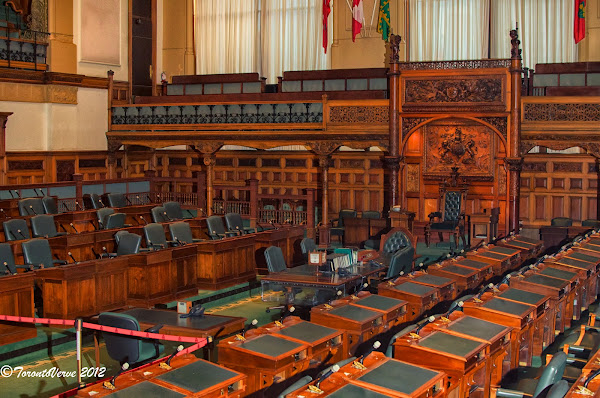
[The Legislative Assembly of Ontario located in the Ontario Legislative Building at Queen's Park]
TV: Did you personally meet with the family members of the victims?
JS: Yes, when I was there, many of the people knew who I was already. So I met a lot of the victims’ families. It was a very emotional time, but there was a lot of hope and a lot of positivity and the community felt very blessed that so many people had driven or flown down from across the States and Canada. That support gave the Wisconsin community a lot of feelings of courage.
TV: What did it mean for you to be there for the funeral service?
JS: I wanted to express solidarity…that we’re not going anywhere. Attacks against the Sikh community doesn’t mean that we’re going to go into hiding. I really wanted people to know that. Yes we’re hurting, but we’re here to stay -- strong and proud. The same rhetoric of “taking back the night”. When something bad happens, you don’t lose hope or courage, but you come back more hopeful and courageous.
TV: In spite of the recent tragedies in Colorado and Wisconsin, Canadians can’t say that gun violence is an American problem. Toronto has seen its share of violence lately; what do you think is the root problem?
JS: Gun violence is a very serious issue and something needs to be done, but what I’m really afraid of is the knee-jerk reaction to say that more laws and more police are the solution. We’ve seen in society that more laws, more police and more punishment are not the solution to systemic problems. You can’t just catch one individual to solve gun violence. If you look at the countries across the world where they have the least amount of violence and compare them to countries with the most violence, you’ll see that the solution is not based on who has the most police and worst punishments. It’s based on which societies have the best protections for their community, who has the strongest social network, which communities have the least gap between the rich and the poor and which societies have the most opportunities for youth and employment. It’s a long and slow solution. It can’t be fixed tomorrow because gun violence is a symptom of a much deeper problem.
TV: What can the community do to help solve this epidemic?
JS: When there’s less hope and opportunity, there’s more despair. With more despair, you’re willing to do anything because there are no other options. I have a nephew and he’s learning his first words from his mother -- my sister. If my sister taught him words like “love”, “respect” and “kindness”, that’s all my nephew would know, but if he was only taught words like “hate”, “hurt” and “harm”, that’s what he would learn instead. Similarly, the community can address the fact that we’re on a particular path because people only know what they’re taught. And if you don’t have the proper role models or the proper social structures that can teach [alternate] options, then you’re left with what you know. And it’s no surprise that parents who are poor, have children who are poor, and parents who are involved in the criminal system, have kids in the criminal system. There’s a clear link between criminality and poverty. So if you only know crime, it’s more than likely that you’ll pass on that lifestyle.
TV: So let’s switch gears to a lighter subject.
JS: Yeah, we were getting deep and heavy there (laughs).
TV: Men’s fashion. After all, that’s how we met. I've approached you three times on the streets of Toronto to photograph your sophisticated street style. How has fashion played a part in your life?
JS: Unfortunately, people judge others by their appearance. We always say ‘never judge a book by its cover’, but that’s what we do, and I realized the same thing was happening to me. I think of clothing as social armour -- if you dress really well, maybe some of the misconceptions and fear that people have can be dispelled by looking sharp. Clothing is a big part of how we interact in society and a well-tailored suit will open doors for you that you wouldn’t otherwise have. I have a turban and beard and some people might feel a little bit uncomfortable with that because they’re not used to it, but by being well-dressed, it helps break the ice and open doors.
TV: And you design your own clothes?
JS: I do. Some are flops, but some turn out really well. I have a tailor in India [who puts my designs together]. I designed a linen jacket and at first glance, everyone loves it, but if you look closely, [it’s obvious that there are flaws]. I did, however, improve on that design with a wool version.
TV: Can you tell us more about your designing process?
JS: Yes, I show the tailor different pictures with my drawings and explain what I want. Occasionally the tailor will tell me that my designs don’t make sense [or they’re impractical]. Sometimes I’ll take their feedback – other times, I won’t, which I learn to regret later. Once I wanted silk lining in some of my suits and the tailor was very adamant that silk lining is a bad idea because silk will always wear out before wool. I didn’t believe him at first, but now I have a number of beautiful Bespoke custom suits with frayed silk inner lining. I should have gone with my tailor’s recommendation and use a sturdier fabric like Bemberg instead.
TV: How would you rate fashion in Canadian politics?
JS: It’s pretty bad. I apologize to all my colleagues (laughing). When I first started in law, like my friends, I had a strict budget for buying suits. My friends bought 10 suits. I wanted to look really well-dressed so I just bought two suits of high quality [and rotated them]. I’ve always done that. People compliment me on my suits and I really don’t have that many. I probably have 5 suits. And that’s what politicians should do. Avoid buying 20 [mediocre] suits and buy 3 of high quality. I think they would be much better off. And they should really support local industry and buy custom-made suits. A lot of suits off the rack don’t fit very well. A custom suit fits better and will last you a lifetime.
TV: Are your peers receptive to your advice?
JS: Some people are. They see it makes sense, but they’ve already gone down a path and it’s hard to shift your paradigm. I read this article in a woman’s magazine about spring cleaning. The question was put: if you have 10 pairs of jeans and you only look good in two of them, why not get rid of the other 8? Just wear what you look best in. Similarly, that’s the argument I raise.
TV: Did you convert anybody?
JS: I’m excited to say that one guy is actually trying out a custom suit.
TV: Last question, what are you most happy about in your life right now?
JS: That’s a really good question. My family had some ups and downs. Right now, we’re on a really strong up. I’m very thankful for my good health and my family being strongly connected. In terms of what I’ve achieved, I’m really proud that I inspire a wide variety of people. Specifically, a lot of young Sikh men and women in my riding come into the office and tell me that they can see themselves becoming lawyers and politicians as well. So I’m really happy that I have the opportunity to touch lives and motivate people to achieve more.
Click 'PLAY' below to see Jagmeet in action at Queen's Park.
Sunday, September 30, 2012
Saturday, September 29, 2012
Tuyaara: Style in the Rain
"I get my inspiration from male fashion, but I add a few girly things. This particular outfit was sewn together by my mother whom I look up to."
Friday, September 28, 2012
Sam: "Vintage & Modern Flair"
"I'm a big fan of designers Alexander Wang and Philip Lim. I like Alexander's edgy style and Philip's feminine fashion."
Thursday, September 27, 2012
Wednesday, September 26, 2012
Meghan: "I'm a Country Girl, But I Love the City"
"I like mixing and matching expensive with cheap. For instance, this Coach bag is limited edition and expensive, but this H&M poncho was only $20. I'm inspired by model Miranda Kerr and I love Model Off Duty style."
Monday, September 24, 2012
Sunday, September 23, 2012
Saturday, September 22, 2012
Amie
"My style is a little eccentric. I like to add pop to my outfits -- could be my bag or shoes. Depending on my day, I like to get wild with the way I dress. I don't like to be boring. Designer Roberto Cavalli inspires me. I love his prints. I think it's phenomenal how he studies nature and brings life to his photographs with his fabrics."
Amie owns a fashion jewellery store that caters to designs from around the world and you can check it out here.
Friday, September 21, 2012
Amber Joliat: Farewell to Summer
It's hard to believe that summer's over, but before we bid it a fond farewell to make way for chilly Fall, let's enjoy one last warm day at Ashbridges Bays (otherwise known as The Beaches or The Beach) with Yoga & Pilates instructor Amber Joliat of Misfit Studio.
TorontoVerve: Amber, you've appeared on TorontoVerve twice before -- the last time celebrating New Year's resolutions and fitness. Since then you've moved your thriving Misfit Studio to a bigger location and you've been named as one of BlogTo's Best Yoga Studios in Toronto. Can you tell us a bit about who you were before your success?
Amber Joliat: I was a dancer -- it was my first language as a child. Always painting and dancing, my life was fuelled by creativity. I started teaching dance when I was 14, working in a company or performing. After finishing my art degree in Italy, I pursued a career in art by drawing and painting. But realizing how difficult it was surviving as a painter, I went back to dance and inevitably taught Yoga and Pilates.
TV: How does dancing help you express yourself?
AJ: It just flows from me. I feel like a vessel of pure divine spirit. And here I am, running a studio 2 years deep. Still trying to figure out HOW to, but following so honestly and truthfully my inner language.
TV: Obviously things are going well for you. How did you feel when BlogTo named you as one of the best Yoga studios in Toronto?
AJ: It's interesting. We live in a time where we want to rank things and make lists. In that sense, it's an honour. In the same breath, I feel like every single day I'm humbled and there's so much more to learn.
TV: You have many unique and artistic tattoos. What inspires your choices?
AJ: My tattoos started at 15 and are like a body map of time -- where I was and what influenced me.
I have chakras, flowers, birds, a dragon, an anatomical heart, and a pirate ship on my back. It continues...my dragon will soon hold a pearl of wisdom, and then, well, I never know when inspiration strikes! They each tell a story. I'm a moving art piece.
TV: Your Yoga classes have been described as 'alternative'. Why is that?
AJ: Yoga is so straight. People roll out their mats and don't talk or laugh. And God forbid if you play loud music -- let alone Rock N' Roll. Part of the success with me and my method is that we're shaking things up. I brought a DJ to the Thomson Hotel and led a Rock n' Roll and a Hip Hop Yoga class in front of 200 people. But, while I bring in this element of playfulness and encourage conversation, I draw from my strong Yoga foundation of 13 years.
TV: So would you say that your Yoga is an evolution from the standard art form?
AJ: Yeah...although people want to have fun and shake things up in Yoga, it still speaks to them spiritually.
TV: Sounds like church. There are churches that are tranquil and serene and other churches where people are jumping up and dancing, but both congregations still receive the same message.
AJ: Exactly, it's like Yoga is the new gospel.
TorontoVerve: Amber, you've appeared on TorontoVerve twice before -- the last time celebrating New Year's resolutions and fitness. Since then you've moved your thriving Misfit Studio to a bigger location and you've been named as one of BlogTo's Best Yoga Studios in Toronto. Can you tell us a bit about who you were before your success?
Amber Joliat: I was a dancer -- it was my first language as a child. Always painting and dancing, my life was fuelled by creativity. I started teaching dance when I was 14, working in a company or performing. After finishing my art degree in Italy, I pursued a career in art by drawing and painting. But realizing how difficult it was surviving as a painter, I went back to dance and inevitably taught Yoga and Pilates.
TV: How does dancing help you express yourself?
AJ: It just flows from me. I feel like a vessel of pure divine spirit. And here I am, running a studio 2 years deep. Still trying to figure out HOW to, but following so honestly and truthfully my inner language.
TV: And what has the response been like from your students?
AJ: They really feel that it's innovative, creative, passionate and expressive, which I guess is new and different. They also feel that there is an authentic sense of community and connection. My philosophy is 'let's just dance, love and learn from each other.' And that actually happens.
TV: Obviously things are going well for you. How did you feel when BlogTo named you as one of the best Yoga studios in Toronto?
AJ: It's interesting. We live in a time where we want to rank things and make lists. In that sense, it's an honour. In the same breath, I feel like every single day I'm humbled and there's so much more to learn.
TV: You have many unique and artistic tattoos. What inspires your choices?
AJ: My tattoos started at 15 and are like a body map of time -- where I was and what influenced me.
I have chakras, flowers, birds, a dragon, an anatomical heart, and a pirate ship on my back. It continues...my dragon will soon hold a pearl of wisdom, and then, well, I never know when inspiration strikes! They each tell a story. I'm a moving art piece.
TV: Your Yoga classes have been described as 'alternative'. Why is that?
AJ: Yoga is so straight. People roll out their mats and don't talk or laugh. And God forbid if you play loud music -- let alone Rock N' Roll. Part of the success with me and my method is that we're shaking things up. I brought a DJ to the Thomson Hotel and led a Rock n' Roll and a Hip Hop Yoga class in front of 200 people. But, while I bring in this element of playfulness and encourage conversation, I draw from my strong Yoga foundation of 13 years.
TV: So would you say that your Yoga is an evolution from the standard art form?
AJ: Yeah...although people want to have fun and shake things up in Yoga, it still speaks to them spiritually.
TV: Sounds like church. There are churches that are tranquil and serene and other churches where people are jumping up and dancing, but both congregations still receive the same message.
AJ: Exactly, it's like Yoga is the new gospel.
Thursday, September 20, 2012
Wednesday, September 19, 2012
Tuesday, September 18, 2012
Gurratan & Jagmeet: Brothers in Style
Unbeknownst to me, my camera has a GPS for NDP MPP Jagmeet Singh's street style because this is the third time that I've bumped into him -- this time with his equally stylish brother, Gurratan.
Gurrantan (left): "My brother says my style is safari-inspired and I agree that it's that kind of vibe. It's hot so for me it's important to be comfortable and stylish at the same time."
Jagmeet (right): "I remember whatever style I was into, my brother would kinda emulate it, but recently, I've seen my him develop into his own person and style."
Monday, September 17, 2012
Anisa: "Sophisticated & Fun"
"I'm Pakistani and Italian so both cultures inspire me. My style is a combination of sophisticated, sleek, professional, but also very fun and upbeat."
Subscribe to:
Posts (Atom)


.jpg)


